If you are planning an office in an industrial area, the fit out can either become your biggest headache or your biggest advantage.
Industrial locations bring real benefits: better lease value, larger floor plates, easier vehicle access, and room to scale. But they also come with constraints that traditional office fit outs do not always account for, like acoustic issues, temperature swings, heavy foot traffic, loading activity, and basic shell conditions that vary wildly from unit to unit.
This guide breaks down what matters most when fitting out offices in an industrial area, what to prioritize first, and how to get a practical, professional result without overspending.
If you want a fit out partner who can design, build, and manage approvals end to end, A ONE INTERIORS can help you scope, plan, and deliver the project with minimal disruption.
Why Industrial Area Offices Need a Different Fit Out Strategy
A typical commercial tower office is designed for office use from day one. Industrial shells are not.
Many industrial area office spaces start as a bare unit with:
- High ceilings and exposed services, which require careful consideration during fit out
- Uneven daylight and glare from large shutters
- Hard surfaces that amplify noise
- Limited HVAC capacity or poor distribution
- Electrical boards intended for light industrial load, not modern workstation density
- Mixed-use needs: front office plus warehouse, workshop, or dispatch areas
A good fit out bridges that gap. The goal is not to make it look like a corporate tower. The goal is to create a high-performing workspace that suits the realities of an industrial environment while still feeling like a proper office for clients and staff.
Step 1: Get Clear on How the Space Will Be Used
Before you choose finishes or furniture, define how the office actually needs to function.
Most industrial area offices fall into one of these patterns:
1) Sales and Admin Front Office + Warehouse Operations
You need a client-friendly front section and a durable, operational back section. Flow matters here.
2) Engineering, Trading, or Technical Office
Higher focus on workstations, meeting rooms, printing zones, sample storage, and sometimes small testing benches.
3) Call Center or Support Team
Density, acoustics, and HVAC performance become the top priorities.
4) Hybrid Team with Frequent Visitors
Reception, meeting rooms, and presentation areas need to feel polished, even if the building is not.
A ONE INTERIORS usually starts by converting these needs into a zoning plan that separates quiet zones from noisy zones, controls visitor access, and keeps operations moving.
Step 2: Space Planning That Fits Industrial Reality
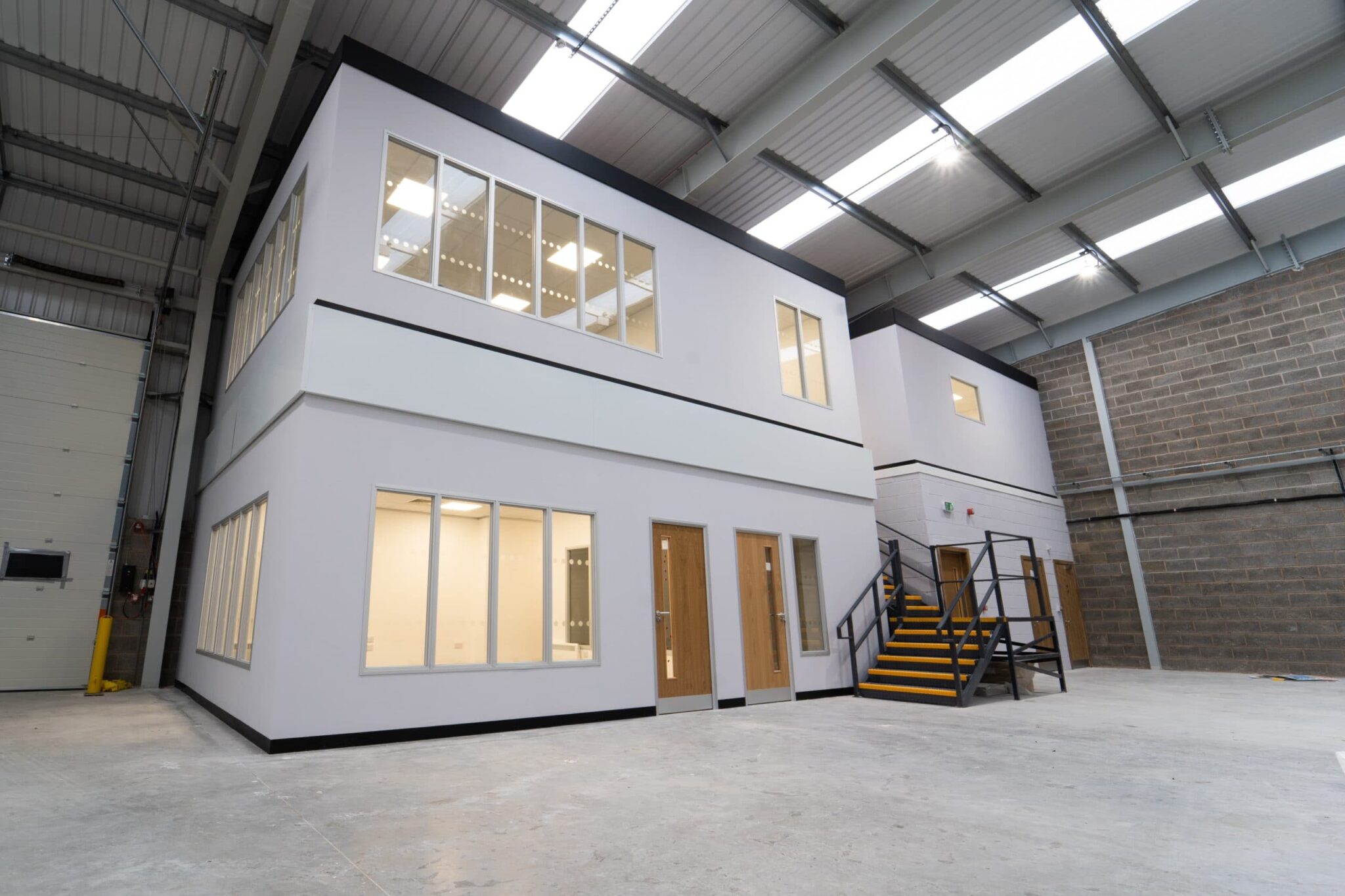
Industrial units often have awkward columns, roller shutter doors, mezzanines, or deep floor plates. That is why a standard office layout template rarely works.
Practical zoning that works
A strong industrial office layout often includes:
- Reception and waiting near the entrance
- A visible but controlled access path for visitors
- Meeting rooms near reception to avoid clients walking through operations
- Open workstations deeper inside for privacy and quieter work
- Pantry and washrooms positioned for easy services routing
- Print and storage zones as acoustic buffers
- Clear separation from warehouse or workshop, using partitioning and door control
Circulation planning matters more than you think
Industrial offices get more movement: deliveries, field staff, warehouse coordination, and visitors. Your layout should prevent bottlenecks and avoid people cutting through focused work areas.
Step 3: Partitioning and Wall Systems (Do Not Overbuild)
Fit out budgets often get drained by over-partitioning. In industrial areas, you want partitions that are:
- Fast to install
- Durable
- Easy to modify later
- Good for acoustics
Best options for industrial office fit outs
- Gypsum partitions with insulation: great for meeting rooms and private cabins
- Glass partitions: ideal for visibility and daylight sharing, but needs acoustic detailing
- Modular partitions: excellent if you expect changes or expansion
For meeting rooms and cabins, acoustic insulation inside the partition and proper door seals are non-negotiable if you want privacy.
Step 4: Flooring That Survives Real Traffic
Industrial area offices typically see dust, heavy shoes, trolley movement, and higher wear. Flooring needs to be chosen for maintenance, not just appearance.
Reliable flooring choices
- Carpet tiles: great acoustics, easy replacement, professional look
- Luxury vinyl tiles (LVT): durable and modern, easy to clean
- Epoxy or polished concrete in operational zones: high durability, industrial feel
A common and effective approach is using LVT for reception and corridors, carpet tiles for workstations and meeting rooms, and epoxy for pantry or utility areas.
Step 5: Ceiling Strategy (Expose or Cover, But Do It Intentionally)
Industrial units often have exposed ceilings with ducts, cable trays, and structural elements. You have two smart paths:
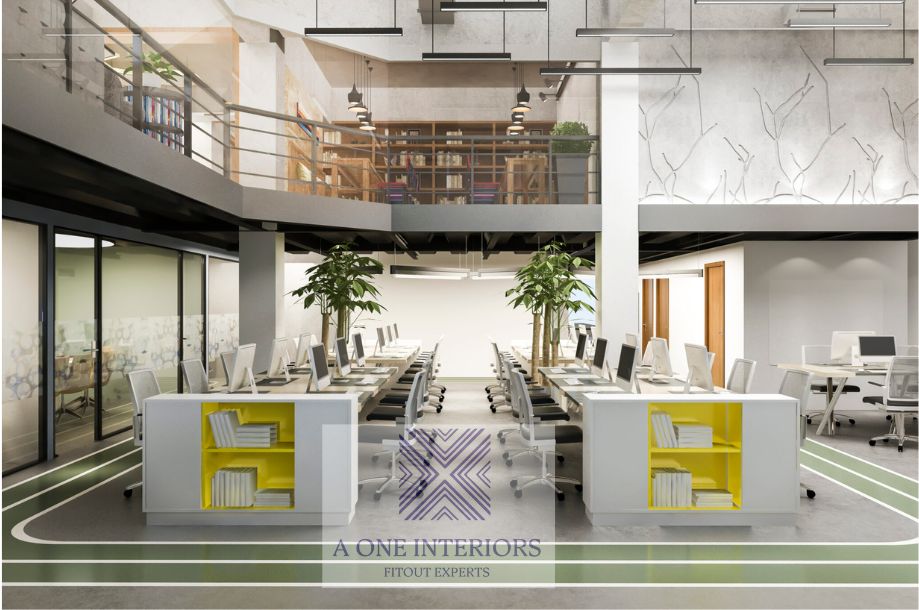
Option A: Open ceiling with acoustic control
This works well if you want a modern industrial look. Add:
- Acoustic baffles or panels
- Proper lighting design
- Clean cable management
- Painted services in a consistent finish
Consider using some of the most effective combined acoustic and illumination products in commercial ceilings for optimal results, as detailed here.
Option B: False ceiling for comfort and control
Best for call-heavy offices, formal meeting rooms, and executive zones. It helps with:
- Acoustic absorption
- Better HVAC distribution
- Cleaner lighting layout
Many projects use a hybrid: closed ceiling in meeting rooms and cabins, open ceiling in open office zones.
Step 6: Lighting That Looks Good and Works All Day
Industrial shells often have harsh lighting or uneven natural light. Office teams need consistent brightness, low glare, and a professional feel.
Lighting principles that work
- Use 4000K neutral white as a safe default for offices
- Add task lighting where needed
- Avoid glare on screens by planning fixture placement carefully
- Use feature lighting in reception and meeting rooms to elevate the space
Do not leave lighting to the end. A good lighting plan changes how the entire office feels, even with simple finishes.
Step 7: HVAC and Ventilation (The Most Common Fit Out Failure)
In industrial areas, HVAC problems show up fast. Heat load is higher, doors open frequently, and many units were not designed for dense office seating.
What to verify early
- Cooling capacity for your headcount and equipment
- Fresh air intake and ventilation compliance
- Zoning for meeting rooms and cabins
- Noise control for indoor units
- Proper drainage and access for maintenance
If your team is uncomfortable, productivity drops and complaints rise. HVAC is not the place to “value engineer” without a proper calculation.
A ONE INTERIORS typically coordinates HVAC layout with ceiling design and workstation planning so airflow and comfort stay consistent throughout the office.
Step 8: Acoustic Treatment (Industrial Areas Are Loud)
Noise from adjacent units, loading bays, trucks, and workshop activity can leak into your office. Inside the office, open plans also create echo and distraction.
High impact acoustic upgrades
- Carpet tiles in open office zones
- Acoustic insulation inside partitions
- Acoustic door seals for meeting rooms
- Wall panels in conference rooms
- Ceiling baffles if you keep an exposed ceiling
You do not need to turn the office into a studio. You just need to control the biggest sources of distraction.
Step 9: Electrical and Data (Plan for Density and Growth)
Industrial units sometimes have limited power distribution for office needs. A professional fit out should plan for:
- Workstation power and data points with spare capacity
- Server or network rack location with ventilation
- UPS planning if required
- Dedicated circuits for pantry equipment
- Meeting room AV power and connectivity
- Clean cable routing underfloor or via trunking
Also consider access control, CCTV, and intercom early so you are not opening walls later.
Step 10: Safety, Compliance, and Approvals
Industrial locations often have stricter requirements depending on the zone and building rules. Your fit out must consider:
- Fire alarm and firefighting integration
- Emergency exit routes and signage
- Fire-rated doors where required
- Occupancy limits and egress widths
- Accessibility where applicable
Approvals vary by municipality and building management. This is where having a contractor who can handle documentation, coordination, and inspections saves serious time.
Reception and Client Areas: Make the First 10 Seconds Count
Even if you are in an industrial area, clients judge you the moment they walk in. Your reception should feel intentional.
Simple ways to elevate reception without overspending
- A clean branded backdrop wall
- Good lighting on the logo
- Comfortable seating and tidy visitor flow
- A meeting room close to reception
- Durable, premium-looking flooring at entry
You do not need luxury finishes. You need a space that feels organized, credible, and well-maintained.
Pantry and Washrooms: Keep Them Practical and Easy to Maintain
Pantries in industrial offices get heavy use, especially for teams that do not have nearby cafes. Design for:
- Enough counter space
- Proper exhaust if cooking is allowed
- Easy-to-clean wall finishes
- Smart storage
- Water filtration if needed
For washrooms, durability matters more than design trends. Use robust fixtures and anti-slip flooring.
Furniture and Joinery: Built for Daily Use
Industrial area offices often run long hours. Choose furniture that supports comfort and heavy use:
- Ergonomic chairs with proper lumbar support
- Workstations with cable management
- Storage that reduces visual clutter
- Meeting tables that match typical meeting size
- Reception desk that supports visitor handling and deliveries
Custom joinery can add polish, but it should be used where it makes a visible difference, like reception, pantry, and key storage zones.
Branding Without Overdoing It
A good fit out should reflect your business, not overwhelm the space.
High-ROI branding ideas:
- Logo wall in reception
- Brand colors in small accents: upholstery, graphics, door frames
- Frosted film on glass with subtle patterns
- A single feature wall in a meeting room for identity and video calls
This keeps the office professional and future-proof.
Budget Planning: Where to Spend and Where to Save
Industrial office fit outs can be cost-effective if you prioritize correctly.
Spend on:
- HVAC and ventilation
- Electrical and data infrastructure
- Acoustic performance for meeting rooms
- Lighting quality
- Durable flooring
Save on:
- Over-customized carpentry in low-visibility areas
- Excessive decorative ceiling work
- Too many fixed partitions when modular would work
- Trend-driven finishes that are hard to maintain
A ONE INTERIORS can help you build a phased plan if you want to move in quickly and upgrade in stages.
Timeline: What to Expect for an Industrial Office Fit Out
Every project varies, but a realistic timeline often looks like:
- Concept and space planning: 1 to 2 weeks
- Detailed design and costing: 1 to 3 weeks
- Approvals and procurement: 2 to 4 weeks
- Execution and handover: 4 to 10 weeks depending on scope
If you need a faster move-in, you can prioritize core infrastructure first and finish non-critical upgrades later.
Common Mistakes to Avoid
These issues show up repeatedly in industrial office fit outs:
- Underestimating HVAC requirements
- Ignoring acoustic problems until staff complain
- Poor lighting layout that creates glare and fatigue
- Not planning data points and meeting room AV early
- Overbuilding partitions and losing flexibility
- Choosing finishes that do not handle dust and wear
- No clear visitor path, causing operational disruption
Avoiding these mistakes upfront usually costs less than fixing them after occupancy.
How A ONE INTERIORS Helps You Deliver the Fit Out Smoothly
A successful industrial office fit out is a coordination project. It is design, services, approvals, procurement, and execution all moving together.
A ONE INTERIORS can support you with:
- Site survey and feasibility review
- Space planning and interior design aligned to operations
- Fit out cost estimation with clear scope breakdown
- MEP coordination: HVAC, electrical, data, lighting
- Partitioning, flooring, ceiling, joinery, and finishing execution
- Compliance coordination and handover support
- A clean project schedule to reduce downtime
If you share your unit size, location, and headcount, the team can propose a layout and a budget range that matches your priorities.
Final Thoughts
Industrial areas are no longer just for storage and logistics. Many businesses run serious operations from these zones, and the right office fit out makes a measurable difference in comfort, productivity, and client trust.
If you approach it with a plan, focus on performance first, and design for the realities of the site, you can build an office that feels modern, professional, and scalable.
If you are ready to start, A ONE INTERIORS can help you plan and execute an industrial area office fit out that works from day one.
FAQs (Frequently Asked Questions)
Why do industrial area offices require a different fit out strategy compared to traditional commercial offices?
Industrial area offices start as bare units with features like high ceilings, exposed services, uneven daylight, hard surfaces amplifying noise, limited HVAC capacity, and electrical boards designed for light industrial loads. Unlike commercial tower offices designed for office use from day one, these spaces need tailored fit outs that address acoustic issues, temperature swings, and mixed-use needs to create a high-performing workspace suitable for industrial environments.
What are the common usage patterns for offices in industrial areas that influence fit out planning?
Most industrial area offices fall into four usage patterns: 1) Sales and Admin Front Office combined with Warehouse Operations requiring client-friendly front sections and durable operational back sections; 2) Engineering, Trading, or Technical Offices focusing on workstations, meeting rooms, printing zones, and sample storage; 3) Call Centers or Support Teams where density, acoustics, and HVAC performance are priorities; 4) Hybrid Teams with Frequent Visitors needing polished reception and meeting areas despite the industrial setting.
How should space planning be approached to accommodate the realities of industrial office environments?
Space planning must consider awkward columns, roller shutter doors, mezzanines, and deep floor plates typical in industrial units. Practical zoning includes placing reception near entrances with controlled visitor access paths, locating meeting rooms close to reception to avoid crossing operations areas, positioning open workstations deeper inside for privacy and quietness, and using print/storage zones as acoustic buffers. Circulation planning is crucial to prevent bottlenecks due to higher movement of deliveries and visitors.
What partitioning solutions are recommended for cost-effective and functional industrial office fit outs?
To avoid budget drain from over-partitioning, use partitions that are fast to install, durable, easy to modify later, and provide good acoustics. Recommended options include gypsum partitions with insulation for meeting rooms and private cabins; glass partitions for visibility and daylight sharing with proper acoustic detailing; and modular partitions ideal for future changes or expansion. Acoustic insulation inside partitions and proper door seals are essential for privacy.
Which flooring materials best withstand the heavy traffic and conditions of industrial office spaces?
Flooring in industrial offices should prioritize maintenance alongside appearance due to dust, heavy shoes, trolley movement, and wear. Reliable choices include carpet tiles for good acoustics and easy replacement; luxury vinyl tiles (LVT) offering durability and ease of cleaning; epoxy or polished concrete in operational zones providing high durability with an industrial feel. A common approach is LVT in reception/corridors, carpet tiles in workstations/meeting rooms, and epoxy in pantry or utility areas.
What ceiling strategies work best in industrial office fit outs to balance aesthetics and functionality?
There are two smart ceiling strategies: Option A is an open ceiling embracing the modern industrial look by exposing ducts and structural elements while adding acoustic baffles/panels, proper lighting design, clean cable management, and consistent finishes. Option B involves installing a false ceiling to enhance comfort and control—ideal for call-heavy offices or formal meeting rooms requiring better acoustic isolation. Each approach should be intentional based on office function.
For collaborative spaces, like open-plan offices or creative studios, Option A could foster a sense of transparency and openness, encouraging idea-sharing and informal interactions. On the other hand, Option B might be more suitable for areas that demand focus and privacy, such as private offices or conference rooms. By dampening noise and creating a more controlled environment, it can enhance productivity and concentration. Ultimately, the choice between these two strategies hinges on the specific needs and goals of the office space.